26/10/2026 → 29/10/2026 · 24 commits
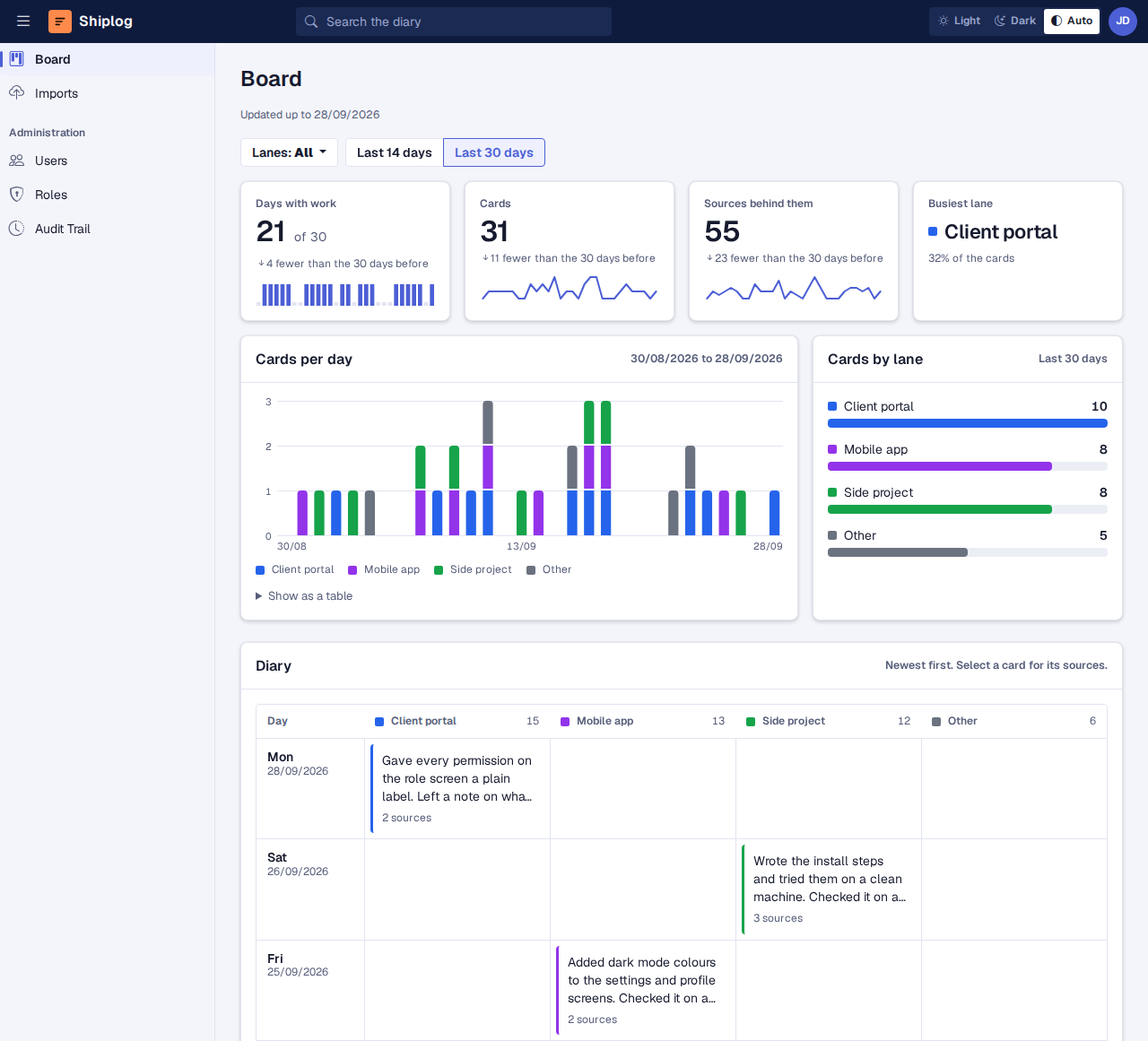
Shiplog
A self-hosted work diary that writes itself from your git commits and Claude Code sessions.
- Role
- Product, design and review by me; code mostly by Claude Code
- Built
- 26–29 October 2026, 24 commits
- Stack
- Laravel 13, PHP 8.4, MySQL 8.4, Bootstrap 5.3, Pest
- Status
- Private for now; a public release is planned
The problem
I tried keeping a work log by hand, and it never lasted more than a week. Meanwhile the real record was already there, in my commits and Claude Code sessions, spread over two client systems. Shiplog turns that record into the diary I never kept.
How it works
- You ask Claude Code to "update my board".
- The
shiplog-updateskill reads the commits and sessions since the last update. It writes one short card per project per day into ashiplog/v1file. - Shiplog checks the file and imports it.
- The board shows days down and projects across. Each card opens to the commits and sessions behind it.
Skill (Update)
Cards lead with the module, the way commit subjects do.
Decisions worth a look
- Imports only add or overwrite, and never half-load. Each card in a file adds the card for its day and project, or overwrites the one already there; cards the file doesn't mention are never touched. If anything in it is wrong, nothing is written and every problem is listed at once.
- The documentation is a test. The README's JSON example is the importer's test fixture, and a test keeps the two identical. The documented format can't drift from what the code accepts.
- No card without a source. The skill is asked to write only what the records show, and the importer enforces the part code can check: a card with no commit hash or session ID behind it is refused.
- Demo mode can't touch a real diary. One setting serves only the read-only board, with no sign-in or upload routes registered at all. The demo seeder refuses to run outside demo mode, and a test starts the app a second time in demo mode to prove it.
The design
The first version looked like a stock admin template. I redesigned it after Power BI and Microsoft Fabric: a dark command bar with jump-to-card search, figures and charts for the last 30 days, and the diary as a grid. I measured the colours for contrast (white text on the buttons is 5.38:1). The motion follows a short set of rules: custom ease-out curves, nothing over 300ms, and fades only under reduced motion.
By the numbers
Measured 2 November 2026.
Limits and what's next
- Claude Code deletes session transcripts after 30 days by default, so older days are built from commits alone.
- Next, I'd have the skill save a short summary of each session when it ends, so older cards no longer depend on transcripts that Claude Code deletes after 30 days.